Due to fire, our power and phone lines are down. Please email us and we will get back to you as soon as we can. If you have an emergency you can call us at our temporary line, 818-438-6840
Why High-Performance Glass is the Secret to an Uncompromised View
In elite residential design, there is a fundamental tension between the desire for transparency and the necessity of control.
While a standard wall provides a predictable thermal barrier, it offers no connection to the horizon.
The Energy Connoisseur refuses this compromise. They understand that a meticulously engineered glass wall should perform with the density of masonry while providing a curated lens to the world outside, ensuring the home’s perimeter is a high-functioning asset rather than a structural weakness.
The Benchmark of Performance: Beyond the Building Code
While our California clients recognize Title-24 compliance as a mandatory hurdle, at Eris, we view it as the baseline for luxury.
These standards for residential fenestration are currently the most rigorous in the United States, defining the frontier of sustainable architecture.
However, even for estates in the humidity of Florida or the high-altitude winters of the Rockies, these benchmarks remain the gold standard.
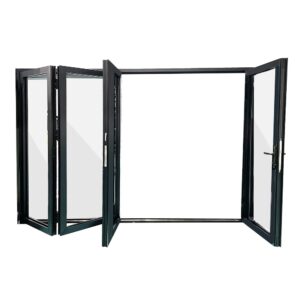
An Eris energy-efficient bifold door system is designed as an “optical envelope” that exceeds these national requirements, ensuring your home remains ahead of the curve in both climate resilience and long-term value.
The Physics of Comfort: U-Factor & SHGC
To the uninitiated, these are mere line items on a spec sheet. To the Energy Connoisseur, they are the metrics that determine the lived experience of a room at high noon.
The Sensory Bridge: Imagine standing inches from a thirty-foot glass wall in the peak of July. In a standard home, you would feel the radiating prickle of heat on your skin.
With an Eris system, that sensation simply doesn’t exist. You are left with the visual brilliance of the sun, but the air around you remains perfectly still and cool, as if the glass weren’t there at all.
The U-Factor (0.29): This measures the rate of heat transfer. At Eris, our systems achieve a 0.29 U-Factor, creating a thermal seal so effective it eliminates the “cold spots” common near large glass spans.
Whether it’s a frost-covered morning or a humid afternoon, the interior temperature remains steady.
SHGC (0.23): The Solar Heat Gain Coefficient is the true guardian of the interior. Our 0.23 SHGC rating means that while the golden hour light is invited in, the infrared heat is rejected.
The result is a room that stays comfortable without forcing the HVAC system into a constant struggle against the sun.
The 75-Series Thermal Break: The Polyamide Barrier
The secret to this stability is hidden within our thermally broken aluminum doors. Because aluminum is a natural conductor, it requires an internal intervention to prevent the outside climate from migrating indoors.
We utilize a 75-Series Thermal Break, a reinforced polyamide bar integrated between the interior and exterior frames. This non-conductive bridge slows heat transfer to a crawl.
When paired with our Argon gas-filled, double-tempered glass, the door doesn’t just look substantial; it remains neutral to the touch, regardless of the solar load on the exterior.
Architectural Flexibility: The “Daily Door” Logic
Efficiency in a luxury home is also a matter of intentional behavior. On days of extreme temperature—whether a peak summer heatwave or a coastal storm—the Energy Connoisseur utilizes the integrated swing-door configuration.
By keeping the primary bifold array sealed and utilizing a single, high-performance “daily” door for transit, you preserve the home’s internal pressure.
It is a sophisticated way to live: maintaining a permanent visual connection to the estate while operating the home with the quiet efficiency of a gallery.
Engineering Snapshot: Thermal Performance Brief
Review these specifications to ensure your high-performance glass wall systems meet the Eris standard of excellence.
Feature
Eris Specification
The Lived Experience
Glass Type
Double-Tempered / Low-E
UV protection for fine interiors and art.
Gas Fill
Argon Gas
Significant acoustic dampening and thermal density.
U-Factor
0.29
Elimination of drafts and cold spots.
SHGC
0.23
Interiors stay crisp even in direct, mid-day sun.
Frame
75-Series Thermal Break
Frames remain neutral to the touch in all climates.
The Eris Verdict
For the Energy Connoisseur, a home is a closed-loop system of efficiency. They demand the “infinite vastness” of a 30-foot glass wall without the thermal tax of a drafty interior.
In the world of Eris engineering, luxury is the invisible barrier that keeps the elements at bay while your living room remains a quiet, temperature-stable sanctuary.
It is the power to open your home when the air is sweet and the confidence to seal it when the weather turns—engineering you can’t see, providing a comfort that defines the modern estate.
Design your environment
Explore our Bifold Doors & Windows and see how Eris is redefining the performance standards of the luxury home. Tag your high-performance project on Instagram @ErisHomeProducts.
1. What makes high-performance glass better than standard glass walls?
High-performance glass is engineered to provide both transparency and insulation. Unlike standard glass, it minimizes heat transfer, prevents drafts, and maintains indoor comfort while still offering expansive outdoor views.
2. What is the U-Factor, and why is it important?
The U-Factor measures how well a material prevents heat from escaping. A lower value, such as 0.29, indicates strong insulation, helping maintain consistent indoor temperatures and eliminating cold spots near glass surfaces.
3. How does SHGC improve indoor comfort?
SHGC (Solar Heat Gain Coefficient) determines how much solar heat passes through glass. A lower rating, like 0.23, allows natural light inside while blocking excess heat, keeping interiors cool and reducing strain on HVAC systems.
4. What is a thermal break, and why is it used in doors?
A thermal break is a non-conductive barrier within aluminum frames that reduces heat transfer. The 75-Series thermal break uses reinforced polyamide to prevent external temperatures from affecting indoor comfort, making doors more energy-efficient.
5. How do energy-efficient bifold doors enhance luxury living?
Energy-efficient bifold doors combine performance and design by offering large, open views without compromising insulation. They help maintain indoor climate stability, reduce energy costs, and provide flexibility with features like a “daily door” for controlled usage.