Due to fire, our power and phone lines are down. Please email us and we will get back to you as soon as we can. If you have an emergency you can call us at our temporary line, 818-438-6840
Modern Iron Doors: A Guide to Design Trends, Technical Specs, and Costs
admin
Home » News » Modern Iron Doors: A Guide to Design Trends, Technical Specs, and Costs
Modern iron doors have evolved from traditional ornamental security features into high-performance architectural systems that improve curb appeal, energy efficiency, and home security.
At Eris Home Products, our modern steel and wrought iron doors are engineered to combine minimalist design with structural durability, insulated glass technology, and long-term weather resistance.
For homeowners executing luxury builds or substantial remodels, understanding the technical ecosystem of these systems is essential for maximizing both aesthetic impact and structural performance.
Which is better, bronze or black iron doors?
Bronze iron doors are often better for architectural styles utilizing natural stone, wood, or warm-toned stucco exteriors, while black iron doors are generally superior for high-contrast, modern minimalist, or contemporary farmhouse designs.
Dark bronze options are frequently favored for their ability to soften the industrial nature of steel and mask minor surface dust, whereas matte black remains the industry standard for creating crisp, sharp geometry.
Do iron doors rust?
High-quality iron doors resist rust when protected by an industrial, multi-layer sealing process consisting of sandblasting, hot-zinc galvanizing, a zinc-rich primer, and a baked-on powder-coated finish.
While lower-tier, wet-painted iron can oxidize when exposed to raw moisture, structural systems treated with a zinc-spray barrier isolate the underlying carbon steel from oxygen, significantly reducing the risk of corrosion for many years, even in humid coastal environments.
Material & Performance Comparisons
Iron Doors vs. Fiberglass Doors
Performance Feature
Modern Iron Doors
Fiberglass Doors
Security
Excellent; rigid metal frame resistance
Moderate; vulnerable to deep casing fractures
Lifespan
Very High; structural steel longevity
High; composite shell durability
Maintenance
Low; surface dusting and glass cleaning
Low; periodic clear-coating required
Custom Design Flexibility
Excellent; precision custom forging options
Moderate; restricted to standard factory molds
Glass Integration
Excellent; heavy-duty operable panels
Good; fixed decorative glass inserts
Iron Doors vs. Natural Wood Doors
Performance Feature
Modern Iron Doors
Natural Wood Doors
Rot Resistance
Excellent; non-porous metallic composition
Low; highly vulnerable to moisture absorption
Maintenance
Low; occasional washing
High; requires stripping and sealing every 2–5 years
Security
Excellent; heavy-duty gauge steel framing
Moderate; dependent on wood species density
Dimensional Stability
Excellent; highly resistant to warping and splitting
Moderate; prone to seasonal expansion and twisting
Is a Modern Iron Entry Right for Your Property?
Best Suited For:
High-Exposure Frontages: Properties exposed to intense solar radiation or heavy, driving rain where standard wood options rapidly degrade.
Primary Perimeter Security: Homeowners requiring a heavy-duty physical barrier who do not want to compromise on natural foyer illumination.
Substantial Remodels & New Builds: Projects where existing rough openings can be engineered or re-framed to accommodate heavy structural loads.
Key Design and Engineering Vectors
Arched Profiles and Weight Distribution
Implementing a true radius arched top converts a standard entryway into a custom estate aesthetic. From an engineering perspective, an arched frame transfers load forces outward into the surrounding wall jacks rather than straight down onto the vertical studs.
Consequently, builders must ensure that the header and king studs are perfectly plumb and reinforced with heavy-duty lag bolts to prevent the heavy iron frame from compressing the rough opening out of square over time.
Narrow Stile Framework and View Maximization
Traditional iron doors rely on wide 4-to-6-inch stiles to handle structural stress. Modern narrow stile variants compress this profile down to 2 inches or less to maximize the visual field and daylight harvesting.
To execute this without sacrificing structural stiffness, premium manufacturers increase the internal steel profile thickness and utilize dual-pane, tempered safety glass that acts as a structural diaphragm within the panel frame.
Privacy Glass Integration (Reeded & Textures)
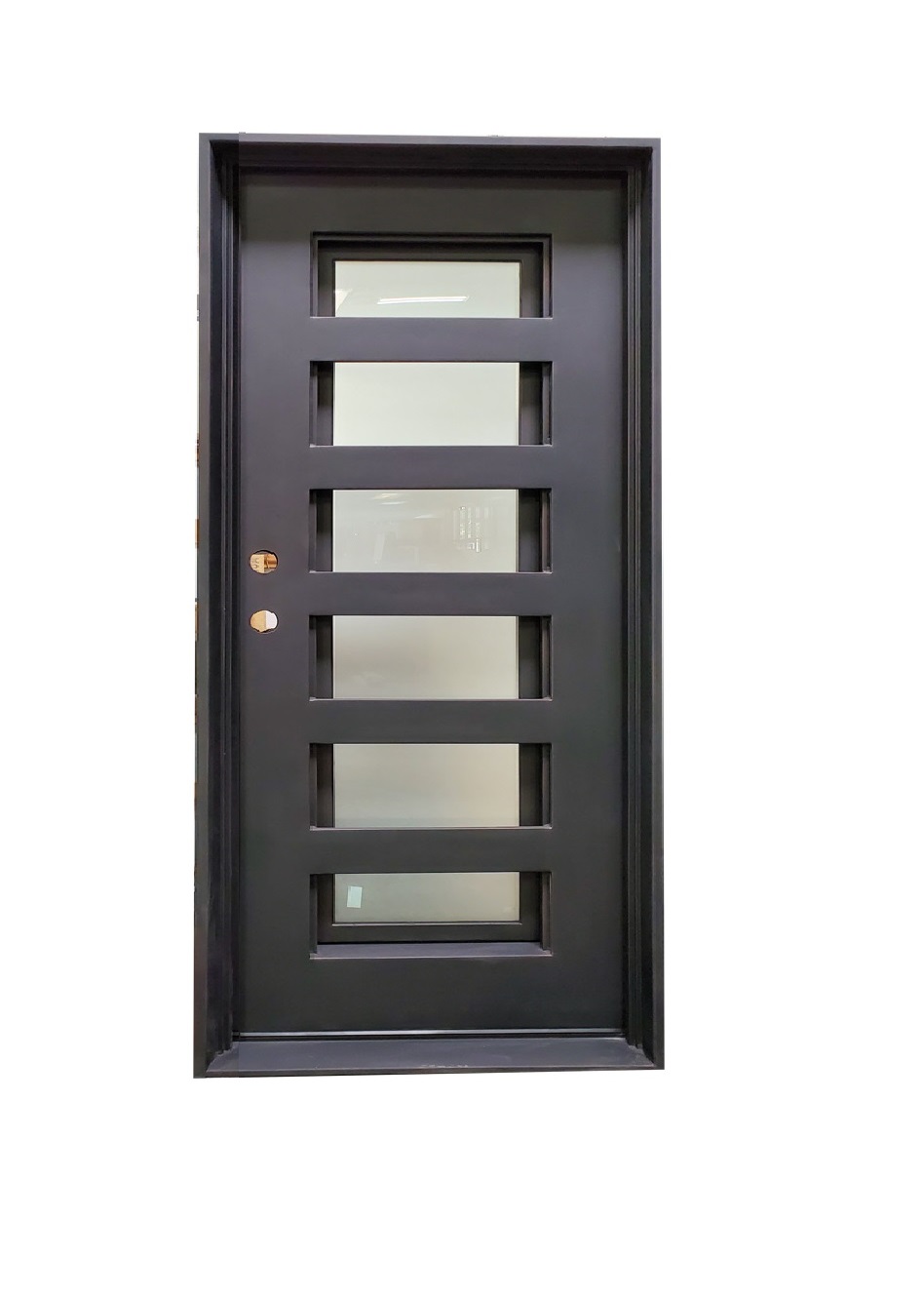
Maximizing light entry can conflict with privacy needs in dense urban or suburban layouts. Utilizing fluted, reeded, or heavily frosted glass textures resolves this issue.
Reeded glass features vertical, semi-cylindrical grooves that distort parallel light rays, preventing direct interior visibility from the street while maintaining a high level of visible light transmission (VLT).
The Eris Verdict: Architectural Steel Engineered for Lifetime Security
Eris Home Products combines modern architectural design with structural steel engineering to create entry systems that prioritize security, energy efficiency, and long-term durability.
From minimalist narrow-style doors to custom arched entries, Eris iron door systems are designed to provide a balance of aesthetics, insulation performance, and structural strength for today’s residential construction projects.
By choosing an engineered steel system, homeowners secure a low-maintenance, architecturally striking primary entrance designed to protect and elevate the property for decades to come.
Make a Lasting First Impression
Your front door is the focal point of your home’s security and architectural identity. Don’t compromise on thermal efficiency or structural strength to get the luxury aesthetic you want.
Explore our Premium Iron Door Collection for custom finishes, glass textures, and modern panel configurations, or contact our specialists to start designing a tailored entry system for your project. Follow us on Instagram@ErisHomeProducts for modern iron door design inspirations.
FAQs
Are iron doors energy efficient?
Modern iron doors can be highly energy efficient when they include polyurethane foam insulation, thermally insulated frames, Low-E glass, and argon-filled double-pane glazing. Premium iron door systems can significantly reduce heat transfer compared to older, non-insulated metal door designs.
Are iron doors safe during hurricanes?
Many steel and wrought iron door systems offer superior structural strength compared to traditional wood doors. However, homeowners in hurricane-prone regions should verify that the specific door system has been tested and certified to meet applicable local impact and wind-load requirements.
How long do iron doors last?
A properly manufactured and maintained iron door can maintain structural integrity for decades. Systems protected by industrial galvanization, zinc-rich primers, and powder-coated finishes are designed to resist corrosion and structural degradation for long-term performance.