Arched iron doors change the character of an entry before anyone touches the handle. A flat-top door sits inside the frame of the house. An arched one softens the opening, draws the eye upward, and gives the facade a sense of age and craft that is hard to get any other way.
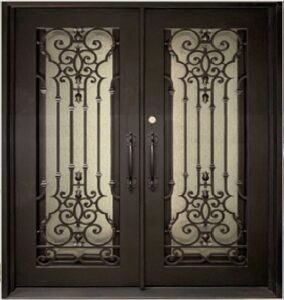
I’m Reza Khoylou, and after more than 15 years in the door business, I’m often asked whether the arch is worth the extra thought it takes. My answer is yes, as long as you plan for it. The double door in the photo shows the look well: a curved top, scrollwork over textured glass, solid lower panels, and matching handlesets. Here are five things to understand first.
1. The Arch Changes How the Whole Entry Reads
A curved top does more than decorate the door. It sets the shape of the entry, and everything around it follows: the trim, the wall above, the lighting on either side. On a Mediterranean or traditional home, an arch usually reinforces what the architecture is already saying. On a modern, boxy facade, it can feel out of place, so look at the lines of your house before you fall in love with the shape.
A simple test: look at your windows, your porch roofline, and any existing arches. If the house already uses curves, an arched door will feel like it belongs. You can browse the full range of styles on our Iron Doors page.
2. The Glass Follows the Curve
In the photo, the glass panels follow the arch at the top, and the scrollwork fills the shape. That is part of what makes an arched door look so complete: the ironwork and the glass are designed to fit the curve rather than being cut to it.
The glass in this example is textured, which scatters the view and keeps the entry private while still letting light through. That balance is worth deciding on early. How much privacy do you want from the front walk? How much light does the foyer need? If you want to see more options, our Double Iron Doors page shows how different glass and scrollwork combinations look in a double configuration.
3. Measuring an Arch Takes More Than Width and Height
A rectangular opening needs width and height. An arched one needs a little more, because the top is curved. Plan to measure:
- Width at the bottom, middle, and the point where the curve begins.
- Height on both sides up to where the curve starts.
- Total height at the center of the arch, which shows how tall the curve rises.
- Photos of the opening straight on, with a tape measure visible for reference.
The rise of the curve is the detail people miss most often, and it affects how the door sits in the opening. If your opening is an unusual shape or size, our Custom Iron Doors are built around your measurements. Custom orders take longer than stock and generally cost more.
4. Construction and Weight Still Matter
An arched door is still an iron door, and it should be built like one. Ours are made from 14-gauge steel with 5/8-inch solid bars. A lower gauge number means thicker steel, and solid bars give the ironwork real structural mass.
Doors and frames are foam-injected for insulation and sealed with weather stripping, with dual-tempered insulated glass and a powder-coated finish for rust protection. A double iron door is heavy, so hinges and hardware need to be rated for the load. It’s a detail worth confirming whenever you compare doors.
5. Plan the Finish and the Surroundings Together
The dark finish in the photo is deep and even, and it contrasts well with light stucco, stone, and plaster. Look at what surrounds the door: wall color, trim around the arch, house numbers, lanterns, and other metalwork. A finish that echoes those elements makes the entry look planned instead of assembled.
If you are replacing an existing door, think about how the new one meets the wall. An arched top may need adjustments to the trim or finish work around the opening, which is a good conversation to have with your contractor before ordering. If your entry is narrower and a double door would feel too wide, a Single Iron Door can carry the same arched look in a smaller footprint.
Arched Iron Doors for Thousand Oaks and Santa Rosa Valley Homes
Thousand Oaks and Santa Rosa Valley include many homes with Mediterranean, Spanish, and traditionally styled entries, where curved lines are already part of the architecture. For those homes, arched iron doors can finish the entry in a way that looks natural, and they hold their appeal well because the style isn’t tied to a trend.
Every home is different, so photos and rough measurements go a long way. I’d rather talk through your opening than recommend a door without seeing it.
Common Questions About Arched Iron Doors
Do arched iron doors cost more than flat-top doors?
Pricing depends on the design, size, and whether the order is stock or custom. Ask us for current pricing on the style you’re considering.
Can an arched door fit a rectangular opening?
Not directly. The opening needs to match the shape of the door, or be adjusted so it does. Talk with your contractor before ordering if you’re changing the shape.
Is the glass in an arched door always textured?
No. Glass style varies by design. Textured, frosted, and clear glass each change how much light and privacy you get, so it helps to decide this early.
Can I get a custom arched door?
Custom sizing and design are available for non-standard openings. Custom orders take longer than stock and generally cost more.
What do I need to request a quote?
Your rough opening measurements, including the height at the center of the arch, a few photos of the entry, and the style you have in mind.
Talk to Eris Home Products
If you are considering arched iron doors for your entry, we’re happy to talk through the measurements, style, and options with you.
Eris Home Products
2300 Corporate Center Dr, Thousand Oaks, CA 91320
Phone: 805-375-6333 | 888-568-9234 | 805-499-0000 | 805-499-3747
Hours: Monday to Friday, 8:00 AM to 4:30 PM
Get directions on Google Maps or request a free quote.