Traditional iron doors don’t have to mean heavy scrollwork. There is a quieter version of the style, built around a divided-glass grid and clean raised panels, and it has been popular for a very long time because it looks composed rather than decorated.
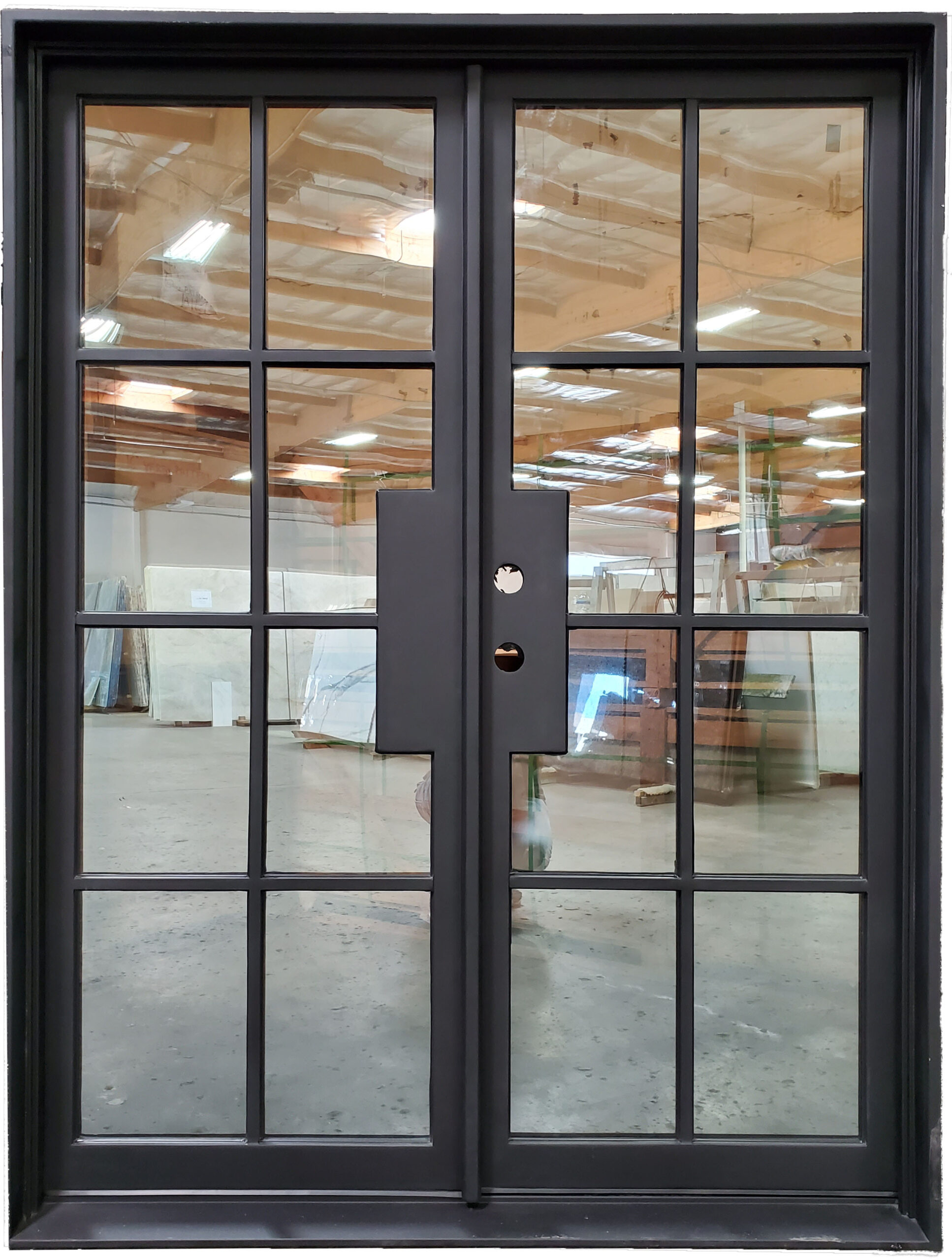
I’m Reza Khoylou, and after more than 15 years in the door business, I find this is the design people choose when they want an iron door but not a statement piece. The double door in the photo shows it well: a curved top, eight panes per door, a raised panel below, and a deep bronze finish. Here are five details that make a design like this work.
1. A Divided-Glass Grid Gives the Entry Structure
Each door in the photo has its glass broken into a grid of small panes. That does something a single large sheet can’t: it frames the view in pieces and gives the door a steady, ordered rhythm. The eye reads the pattern first and the glass second.
It also changes how the entry feels from inside. Light still comes through every pane, but the grid breaks it into a soft pattern across the floor. You can see the range of iron door styles on our Iron Doors page, from this kind of grid to more ornate designs.
2. The Solid Lower Panel Grounds the Door
Below the glass, each door has a raised solid panel. It’s a small detail with a real effect on proportion. Glass all the way down can make a door look light and modern. A solid lower section gives it weight and visual stability, the way a base does for a column.
It’s also a traditional layout, with glass above and a paneled section below, that shows up across classic architecture. If your home has paneled interior doors or wainscoting, this lower panel echoes them.
3. An Arched Top Softens a Double Door
A double door has a lot of width, and a flat top can make it feel boxy. The curve in the photo relaxes that, and the glass in the upper section follows the arch, so the shape feels deliberate rather than cut to fit.
If your entry is a standard rectangle, the same grid design works with a flat top, and our Double Iron Doors page shows what’s available. For narrower entries, the look carries over to a Single Iron Door.
4. Built Like an Iron Door Should Be
The grid is the design, but construction is what makes the door last. Our iron doors are built from 14-gauge steel with 5/8-inch solid bars. A lower gauge number means thicker steel, and solid bars give the ironwork real structural mass.
Doors and frames are foam-injected for insulation and sealed with weather stripping, with dual-tempered insulated glass and a powder-coated finish for rust protection. A double door is heavy, so the hinges and hardware need to be rated for the load. That’s a detail worth asking about when you compare doors.
5. Hardware and Finish Complete the Look
The door in the photo is shown without handlesets, so you can see the openings where the lock and deadbolt go. That’s a useful reminder that hardware is part of the design. The style you choose, whether a classic handleset or something more minimal, sets the final tone.
The bronze finish is deep and even, and it sits well against stucco, brick, and stone. Look at the other metals around your entry, such as lanterns, house numbers, and railings, and choose hardware and finish that echo them. If you want a specific size, pattern, or glass layout, our Custom Iron Doors are built around your opening and your design.
This is the question I hear most. Scrollwork is decorative and dramatic, and it works best when the entry is meant to be the main event. A grid is calmer and more architectural, and it works best when the door should belong to the house rather than stand out from it.
If you like the French-door look but want a different material, our aluminum French and Single Doors are worth comparing too. The right choice depends on your home’s style and how you want the entry to feel.
Traditional Iron Doors for Newbury Park and Conejo Valley Homes
Newbury Park and the wider Conejo Valley have a good number of homes with traditional and transitional exteriors, where a restrained iron door with a divided-glass grid fits naturally. It adds presence without competing with the rest of the facade, which is often what homeowners are after.
Every entry is different, so photos and rough measurements go a long way. I’d rather talk through your opening than recommend a design without seeing it.
Common Questions About Traditional Iron Doors
What makes an iron door traditional?
Usually a classic layout: divided-glass panes or scrollwork, raised solid panels, and a dark, warm finish. The grid design in this article is one of the most common traditional styles.
Is a divided-glass grid more private than a single large pane?
It breaks up the view, but privacy depends mostly on the glass type. Clear, textured, and frosted glass each give a different level of privacy.
Can I get a flat-top version of this design?
Yes. The grid pattern works with an arched or a flat top, depending on your opening and the look you want.
Can I choose my own hardware?
Hardware is part of the design and affects the final look. Ask us about options for the specific door you’re considering.
What do I need to request a quote?
Your rough opening width and height, a few photos of the entry, and the style you have in mind.
Talk to Eris Home Products
If you are considering traditional iron doors for your entry, we’re happy to talk through the design, size, and options with you.
Eris Home Products
2300 Corporate Center Dr, Thousand Oaks, CA 91320
Phone: 805-375-6333 | 888-568-9234 | 805-499-0000 | 805-499-3747
Hours: Monday to Friday, 8:00 AM to 4:30 PM
Get directions on Google Maps or request a free quote.