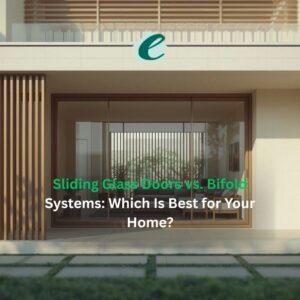
Outswing bifold doors fold outward onto your patio instead of into your room, and that one detail changes more than most people expect. It decides where the panels end up, how much floor space you keep inside, and what needs to be clear outside before the doors can open.
I’m Reza Khoylou, and after more than 15 years in the door business, this is the configuration where I see the most avoidable surprises. The photo above shows why people like it: black aluminum frames, a covered patio, and a dining room that opens straight onto the garden. Here are five things to check before you order.
1. Check the Space Outside the Opening
With outswing bifold doors, the folded panels stack on the exterior side of the wall. That means you need clear space outside, beside the opening, for the stack to sit. Walk out to the patio and look at the wall on either side of the doorway. Is there room, or is a window, a gas meter, a downspout, or a corner in the way?
A folded stack has real thickness, and it grows with the number of panels. A three-panel system stacks smaller than a six-panel one, so panel count and available wall space need to be decided together.
2. Decide Which Way the Panels Stack
Bifold doors can stack to the left, to the right, or split to both sides. Configurations are written as short codes, such as 1L3R, which means one panel on the left and three folding to the right. The right choice depends on where you walk, where the view is, and what you want kept clear when the doors are open.
Stand in the room and picture the doors open. Which side do you want free? Which side can take a stack of glass without blocking a path? Our Shop Bifold Doors page lists the configurations we keep in stock, so you can compare layouts side by side.
3. Think About the Patio Cover
When an outswing system is open, the panels sit outside. A roof overhang or covered patio gives that stack some shelter, which is part of why the setup in the photo works so well. Under a deep eave, the open doors sit in shade instead of full sun.
The alternative is inswing, where the panels fold into the room. That keeps the glass indoors but uses interior floor space. Neither is better in general. If your patio is covered and your room is tight on space, outswing tends to fit. If the patio is exposed and the room has space to spare, inswing may be the better choice. We carry both in stock.
4. Plan the Swing Path
An outswing door needs clearance in front of it as well as beside it. Before ordering, look at everything on the patio near the opening: planters, a grill, outdoor furniture, steps, landscaping. In the photo, the planters are placed well away from the door line, which is exactly the kind of detail that makes the doors easy to live with.
A good test is to mark the swing area with tape on the patio. If you would have to move something every time you open the doors, you’ll stop opening them, and the whole point of the system is lost.
5. Choose Between Stock and Custom Sizing
Our stock bifold doors run from about 72 inches up to 216 inches wide, in black and white finishes, with outswing and inswing configurations. If your opening fits a stock size, that’s usually the faster route. Our bifold systems use a 75 series aluminum profile with a thermal break and 5mm tempered glass in a slim frame. The full range is on our Bifold and Patio Doors page.
If the opening is non-standard, or you want a specific panel layout, our Custom Bifold Doors are built around your measurements. Custom orders take longer than stock and generally cost more, so it’s worth deciding early.
Outswing Bifold Doors for Santa Rosa Valley and Conejo Valley Homes
Homes across Santa Rosa Valley and the wider Conejo Valley often have patios and yards that are used for a good part of the year, thanks to the dry, warm climate. For homeowners with room outside the opening, outswing bifold doors are a practical way to keep the interior floor plan open while connecting the room to the yard.
Every property is different, though. Roof lines, wall space, and patio layout vary from one home to the next, which is why I’d rather talk through your specific opening than recommend a configuration without seeing it. Photos and rough measurements are enough to get started.
Common Questions About Outswing Bifold Doors
What is the difference between outswing and inswing bifold doors?
Outswing panels fold outward onto the patio. Inswing panels fold into the room. Outswing saves interior floor space but needs clearance outside. Inswing keeps the folded panels indoors but takes up room space.
Can I choose which side the panels stack on?
Yes. Panels can stack left, right, or on both sides, depending on the configuration you choose.
Do outswing bifold doors need a covered patio?
No, but a covered patio gives the open panels some shelter. If your patio is exposed, it’s worth discussing whether inswing fits your space better.
Are outswing bifold doors available in stock?
Yes. We keep both outswing and inswing configurations in stock, in black and white. Custom sizing is available for non-standard openings.
What do I need to request a quote?
Your rough opening width and height, a few photos of the opening from inside and outside, and the side where you’d like the panels to stack.
Talk to Eris Home Products
If you are planning outswing bifold doors for your patio, we’re happy to talk through the layout with you.
Eris Home Products
2300 Corporate Center Dr, Thousand Oaks, CA 91320
Phone: 805-375-6333 | 888-568-9234 | 805-499-0000 | 805-499-3747
Hours: Monday to Friday, 8:00 AM to 4:30 PM
Get directions on Google Maps or request a free quote.