
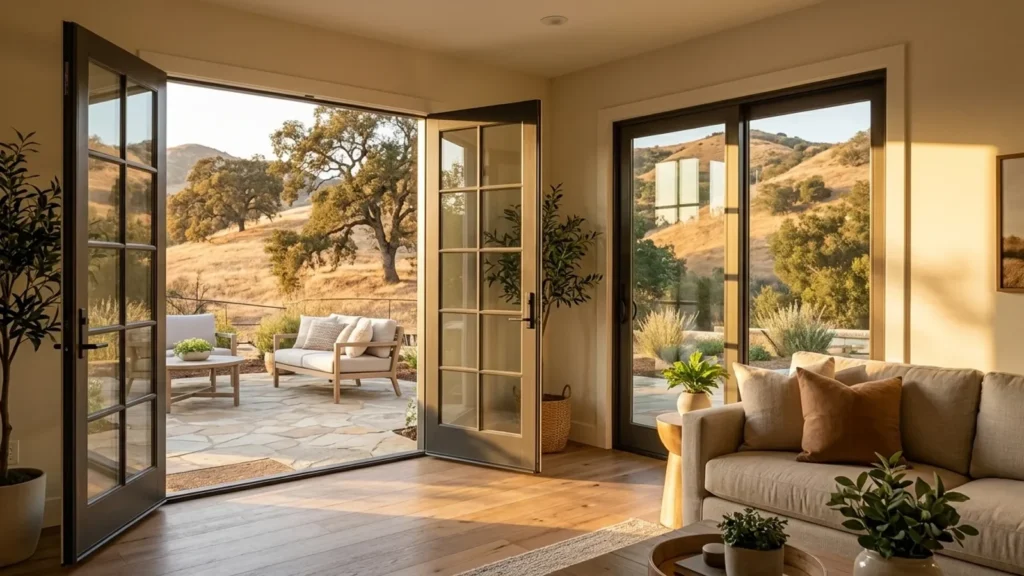
For exterior french doors vs sliding patio doors thousand oaks homeowners usually land on this: sliders win where floor space is tight, and French doors win where you want a wide, fully open doorway and firm compression seals. Both can perform well thermally. The glass and frame matter more than the door style itself.
| Question | Short answer |
|---|---|
| Which needs less floor space? | Sliding doors. The panel moves along a track and never swings into the room. |
| Which opens wider? | Double French doors. Both panels open, so the full frame width is clear. |
| Which usually seals tighter? | French doors, because they press against compression weatherstripping when closed. |
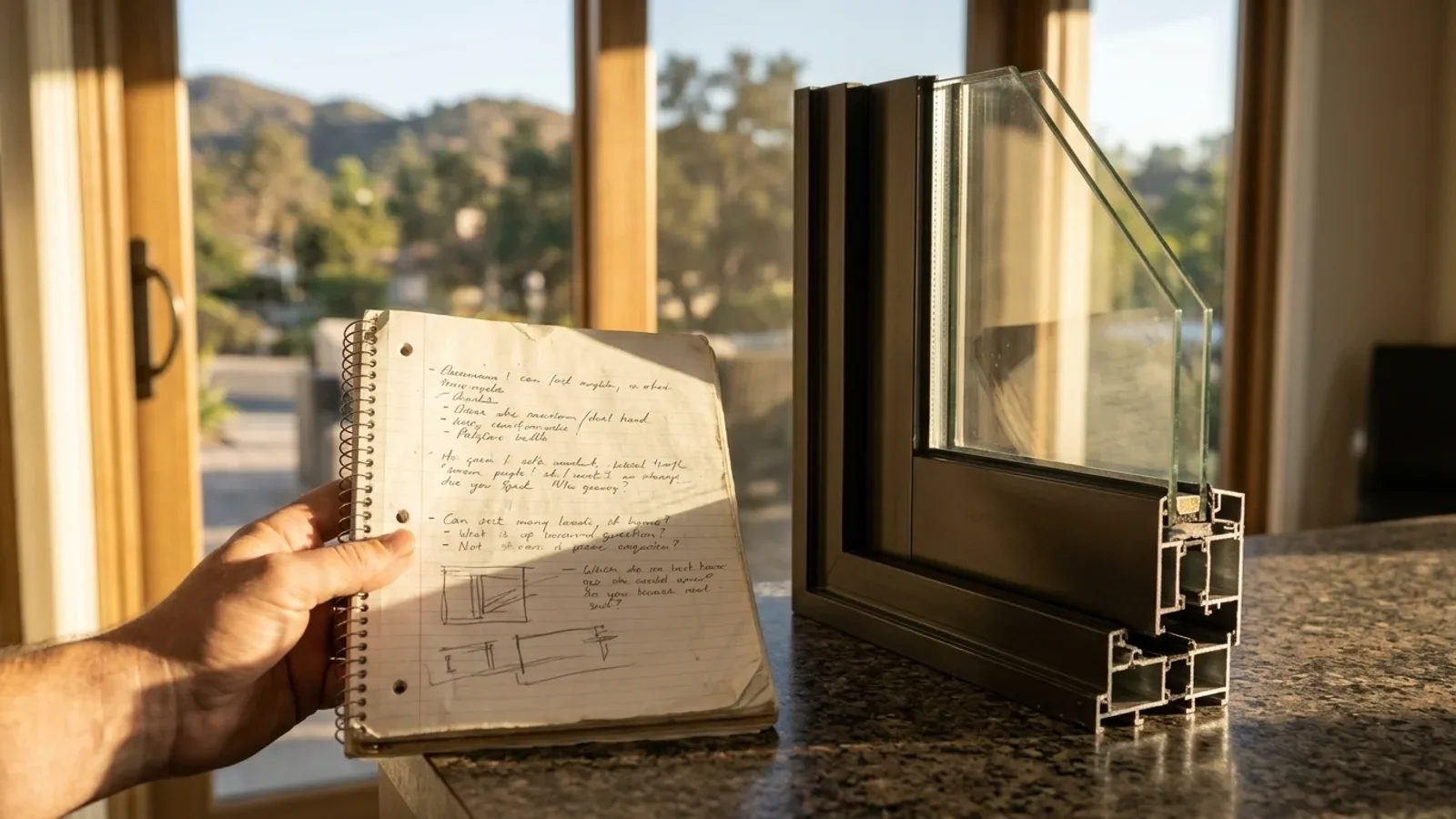
| What drives thermal performance most? | The glass package and the frame, shown as U-factor and SHGC on an NFRC label. |
| What does a French door need to swing? | A clear arc roughly as deep as one panel is wide, inside or out. |
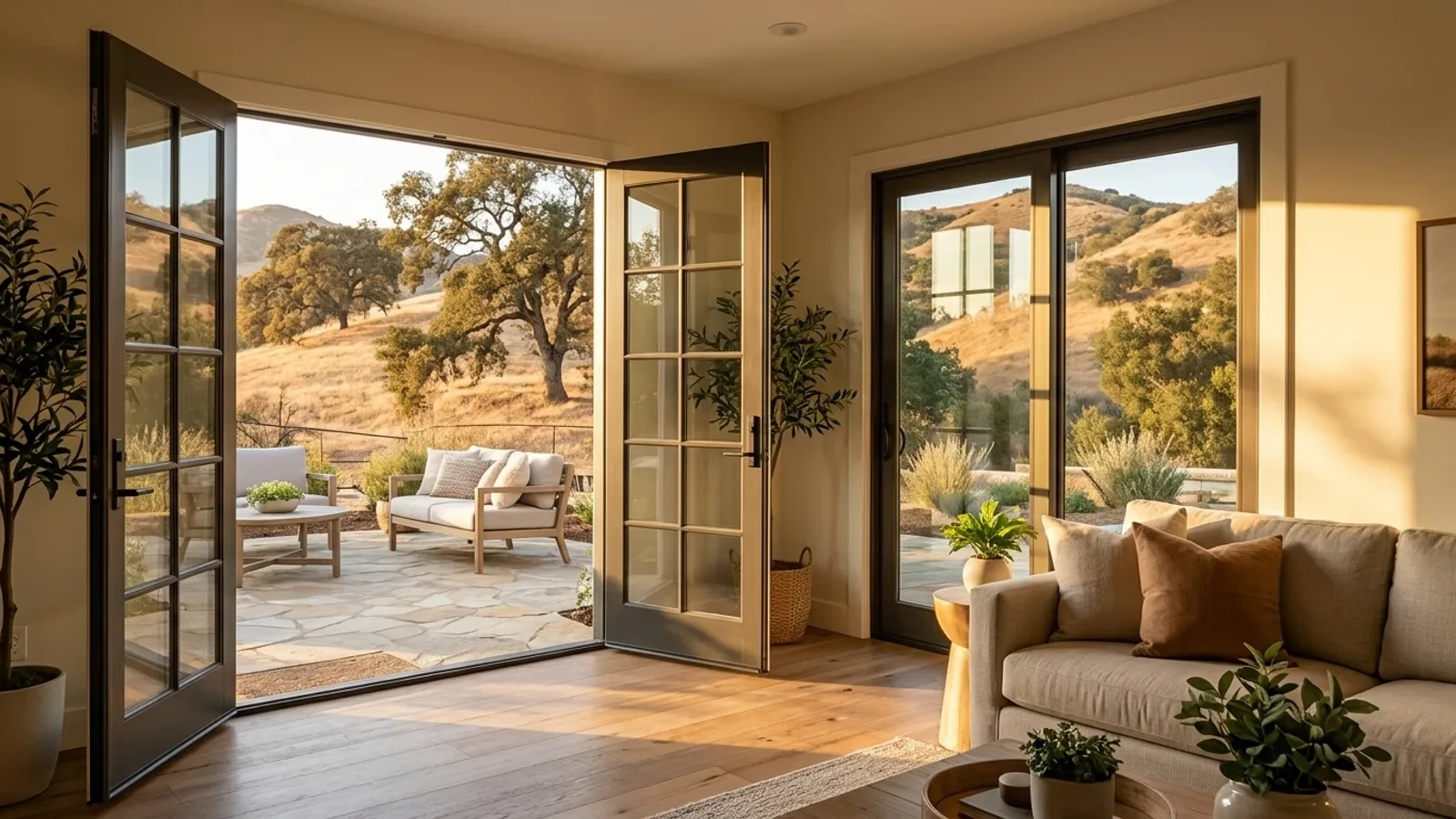
French patio doors are hinged doors, usually in pairs, with large glass panels that swing open like a regular door. When both sides open, the whole doorway is clear. Nothing sits in the middle.
That clear opening is their big draw. You can carry a patio table straight through. Guests can drift from the kitchen to the yard without stepping around a fixed panel. It feels like the wall just went away.
The trade is space. Each panel needs room to swing. An inswing door (one that opens into the house) eats floor area near the threshold, so furniture can’t sit there. An outswing door opens onto the patio, which frees the room but takes up deck or patio space instead. It can also catch wind when it’s open.
On the thermal side, French doors close against compression weatherstripping. That means the door presses into a rubbery seal around the frame, a bit like a fridge door. Pairs also use an astragal, a strip where the two panels meet, plus multipoint locks that pull the door snug in several spots. Done well, that adds up to a tight seal.
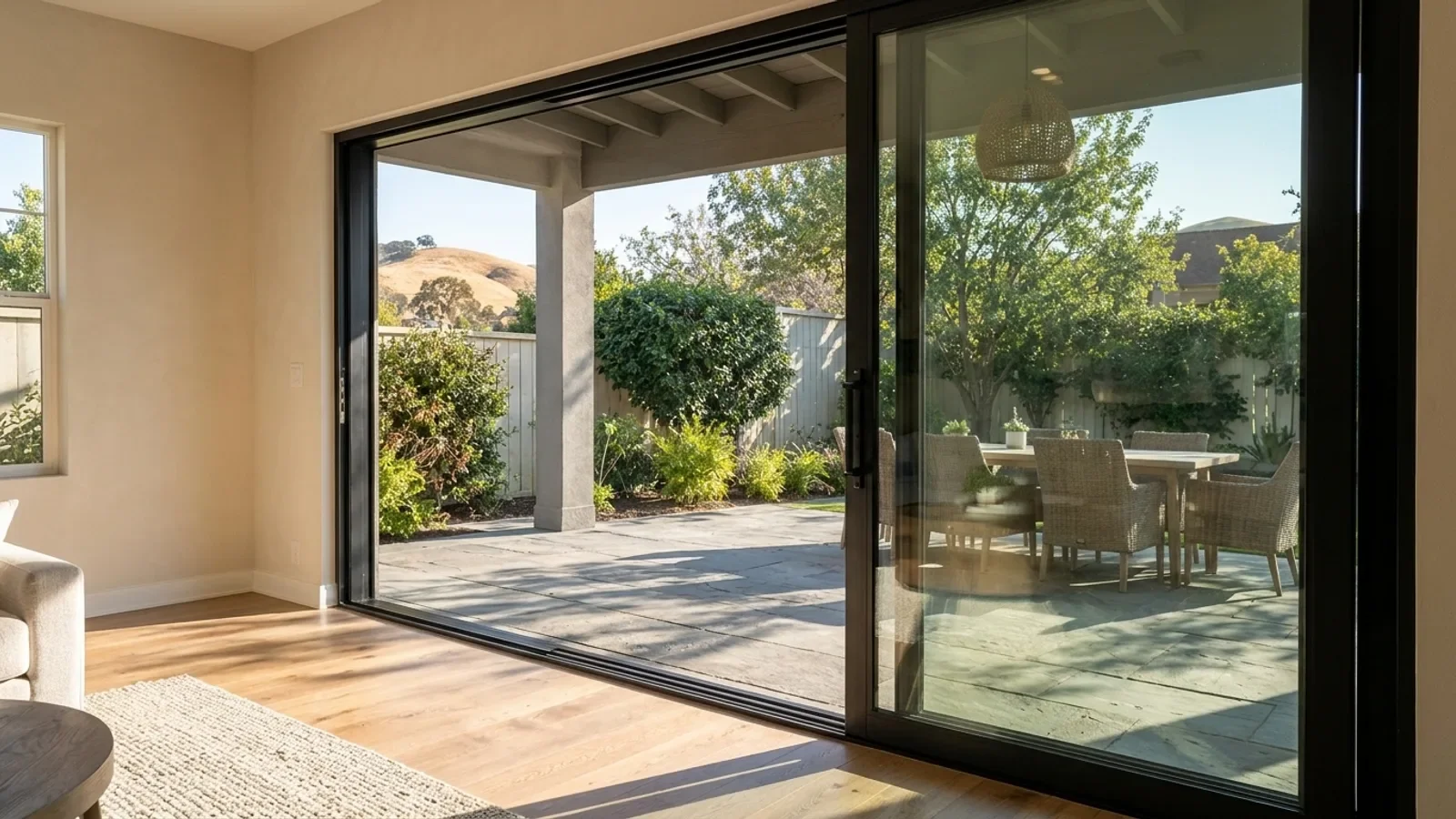
Sliding patio doors have one or more glass panels that glide along a track, with one panel usually fixed. They need zero swing space. That’s the whole point.
In a narrow dining nook or a family room where the sofa sits close to the glass, a slider just works. You open it with one hand and nothing bumps the furniture. On a small patio, nothing blocks the outdoor space either.
The opening is narrower, though. On a standard two-panel slider, only about half the frame width opens, since the panels stack behind each other. Multi-panel sliders can widen that a lot.
Sliders seal with brush or pile weatherstripping along the moving edges. Pile is a dense, fuzzy strip that lets the panel glide while blocking drafts. Modern sliders with good interlocks can seal well. Still, a sliding seal relies on contact rather than pressure, so it tends to wear sooner and show leaks first, especially when the track gets dirty or worn.
Neither style is automatically more efficient; a well-built French door and a well-built slider with the same glass can land close together. The frame, the glass and the seals decide the result. Style comes second.
Here’s what to look at on any door:
These numbers appear on the NFRC label, a rating sticker from the National Fenestration Rating Council that lets you compare doors fairly. If a door doesn’t show one, ask why.
Older doors are a separate story. Drafts, fogged glass between panes or a hot glass surface on summer afternoons can point to a door that’s losing ground. Our guide on spotting a patio door that’s leaking heat walks through those signs.
A French door needs a clear swing arc about as deep as each panel is wide, on whichever side it opens. For a pair of standard panels, that’s a sizable half-circle of floor you can’t furnish.
That space is easy to forget when you’re shopping. Measure it before you fall for a look. Tape the arc on the floor and live with it for a day.
Things that commonly get in the way:
If the arc won’t fit, a slider is usually the practical answer. A single French door with fixed glass sidelites is another option, since it swings less floor. For more ideas, see patio door choices for tight rooms.
This table sets the two styles against the factors that matter most for a typical Thousand Oaks home. No single row decides it.
| Factor | Exterior French doors | Sliding patio doors |
|---|---|---|
| Floor clearance | Needs a full swing arc inside or out | None; panels move along the track |
| Usable opening | Full frame width with both panels open | Usually about half on a two-panel unit |
| Weather seal | Compression seals and multipoint locks | Brush or pile seals with interlocks |
| Ongoing care | Check hinges and door alignment | Keep the track clean, check rollers |
| Wind exposure when open | Outswing panels can catch gusts | Panels stay in their track |
| Look and feel | Traditional, framed, symmetrical | Clean, wide glass, more modern |
Thousand Oaks sits inland in the Conejo Valley, so patio doors deal with more heat and wind than doors right on the coast. That changes what matters most.
Summers are hot and dry, and afternoon sun pounds west- and south-facing glass. A lower SHGC on those walls can help keep a room from turning into an oven. Nights cool off a lot, even in summer. So the door has to handle a real swing in temperature every day.
Then there are the Santa Ana winds. They show up mostly from fall into winter, and late November is right in that window. Dry gusts push fine dust into any gap. That’s hard on slider tracks and worn brush seals. It’s also a reason to think twice about an outswing French door on an exposed patio, since a gust can grab an open panel.
The housing stock matters too. Much of the city was built out in the decades after it incorporated in the 1960s, and many ranch and tract homes from that era still have older aluminum sliders. Those frames often lack a thermal break. Swapping one usually means choosing between a modern slider in the same opening or widening the space for French doors. Permit and opening-change rules vary, so check with the city or a licensed pro before planning structural changes.
Sliding patio doors often cost less than comparable French doors, but not always. Size, glass package, frame material, hardware and whether the opening has to change all move the number more than the style does.
A pair of French doors carries more hardware. Think hinges, an astragal and multipoint locks on two panels. A large multi-panel slider with upgraded glass can climb just as fast. The fair way to judge is to compare doors with the same glass ratings and similar frames. Our list of questions to ask a patio door supplier helps keep that comparison honest.
Vinyl sliding patio doors can be a solid choice; vinyl frames don’t conduct heat much and need little upkeep. They’re usually bulkier than metal frames, though, so the glass area can be smaller for the same opening.
In strong sun, color choice is worth checking, since darker frames absorb more heat. Aluminum is the other common route. It allows slimmer frames and bigger glass, and a thermally broken aluminum frame narrows the energy gap. Which suits you depends on the look you want and how much sun the wall gets.
Choose a slider when floor space is tight, and choose French doors when you have room for the swing and want a wide, fully open doorway. That one question settles most cases.
A few quick rules of thumb:
If you’re still torn, reach out to Eris Home Products in Thousand Oaks. Seeing French patio doors and sliding patio doors side by side makes the choice much easier.
Some parts of this choice are simple. Others are worth handing to a professional.
When you’re ready to pick a style, contact Eris Home Products to talk through French and sliding patio door options for your home and bring your measurements along.
Get expert advice for your project.
Contact us today!