
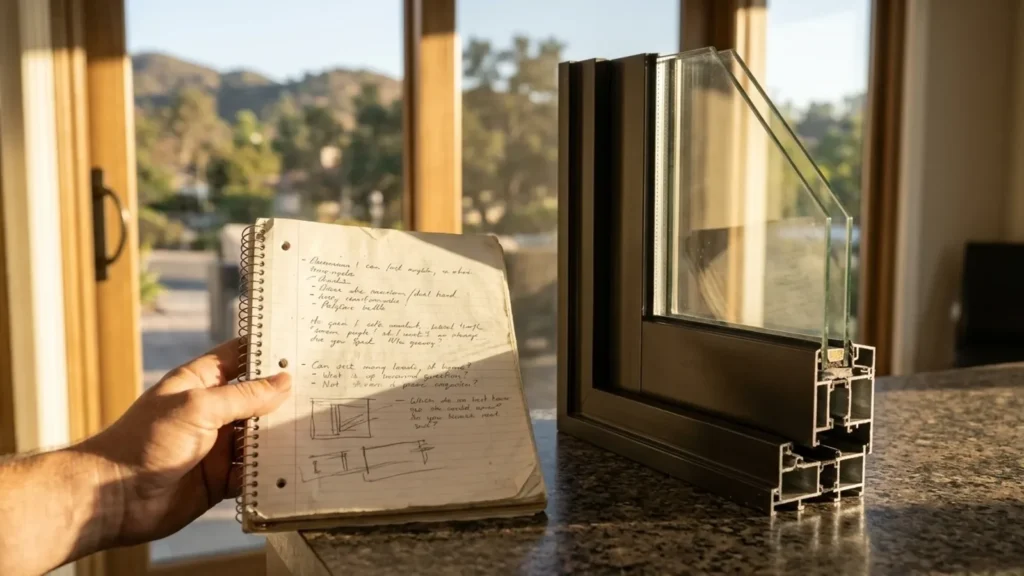
The questions to ask patio door supplier Thousand Oaks shoppers need cover seven things: glass ratings, heat control, frame strength, door type, hardware, sizing and paperwork. You hear the old slider rumble on its track and feel warm air pushing through the gap. This seven-step guide lets you walk into any showroom and compare doors with confidence.
Most people shop patio doors by looks first. That’s natural. The trouble is that two doors can look almost identical and behave very differently once the afternoon sun hits them or a dry wind comes over the hills. The questions below help you see past the finish. Each step is something you can do yourself, with a notepad and a little patience.
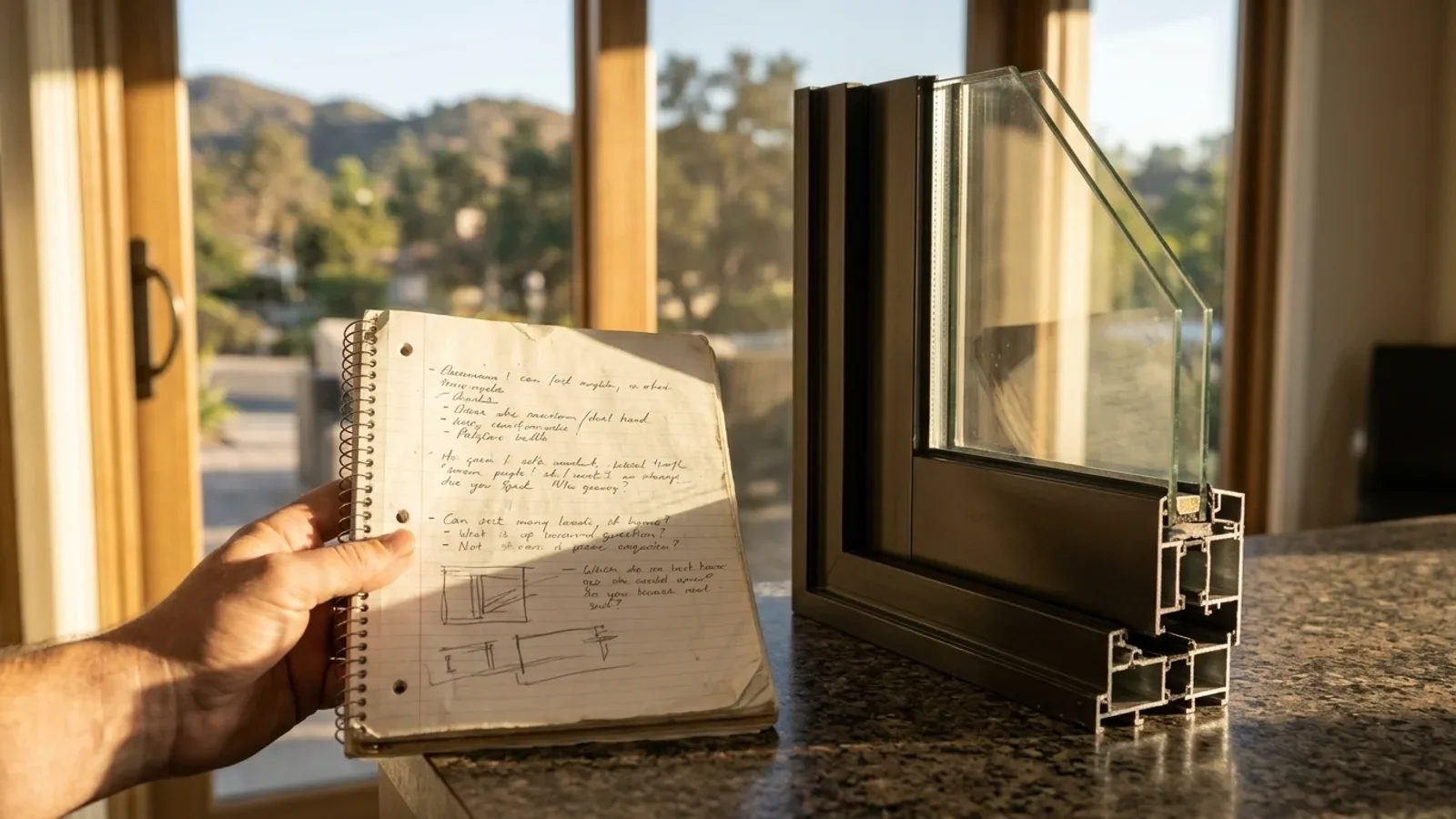
Gather a few things before you call or visit a supplier. It saves time on both sides.
Start by asking for the U-factor and SHGC of every door you’re considering. U-factor tells you how fast heat moves through the whole door; lower is better at keeping indoor temperatures steady. SHGC, short for solar heat gain coefficient, tells you how much of the sun’s heat gets through the glass. Lower means a cooler room on bright days. Ask whether the numbers come from a label on the actual door unit or just from the glass alone. Whole-unit numbers are more honest. They include the frame, which is where a lot of heat sneaks in.
Thousand Oaks sits inland, so summer afternoons run hotter and drier than they do at the beach a short drive away. Nights can still turn cool, especially in the valleys, which means a patio door here fights big swings between day and night. Fall brings Santa Ana winds, the dry gusts that push dust into every gap and test how tightly a door seals. A lot of local homes also date to the 1960s through the 1980s and still have their original aluminum sliders, often single-pane with worn tracks. So ask the supplier plainly: how does this door perform with strong west sun, wide temperature swings and wind-driven dust? A good answer mentions coatings, seals and frame design, not just style. Parts of the area also fall in wildfire hazard zones, and building requirements for glass and openings can differ there. Requirements vary by address, so check with the city or a licensed pro. For a deeper look at how these factors compare across door types, see {{pillar_url|how patio door thermal efficiency plays out in the Conejo Valley}}.
Ask what the frame is made of and how thick its walls are. Aluminum is strong and slim, which is why it suits big glass panels and bifold systems. Plain aluminum also carries heat well, which is not what you want here. That’s why you should ask about a thermal break. A thermal break is a strip of less conductive material built into the frame that separates the inside metal from the outside metal. It slows heat moving through. Then ask how the frame stays stiff on wide openings. A flimsy frame can flex in wind, and flex lets air in.
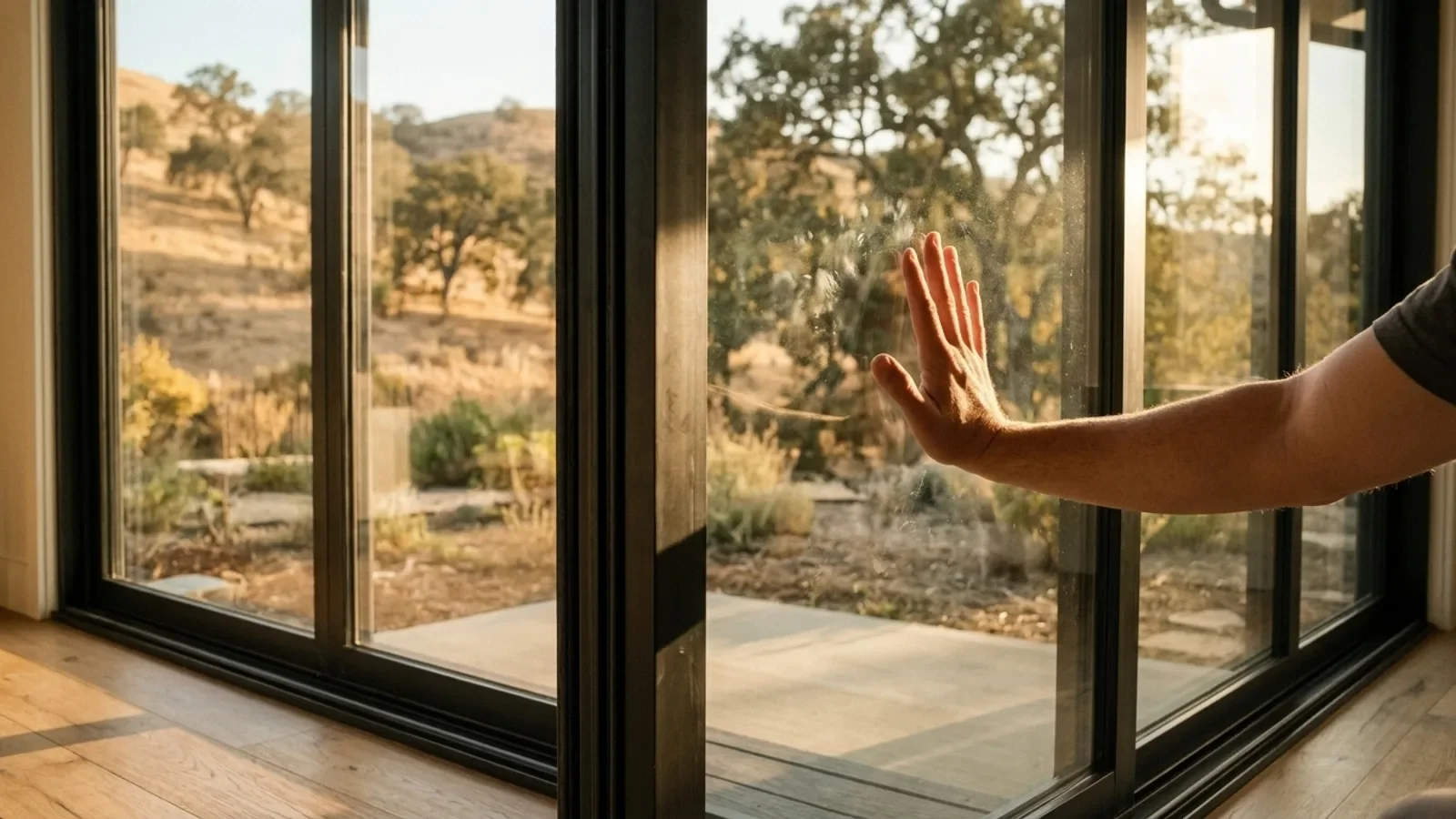
Touch the sample. Weight and feel tell you a lot.
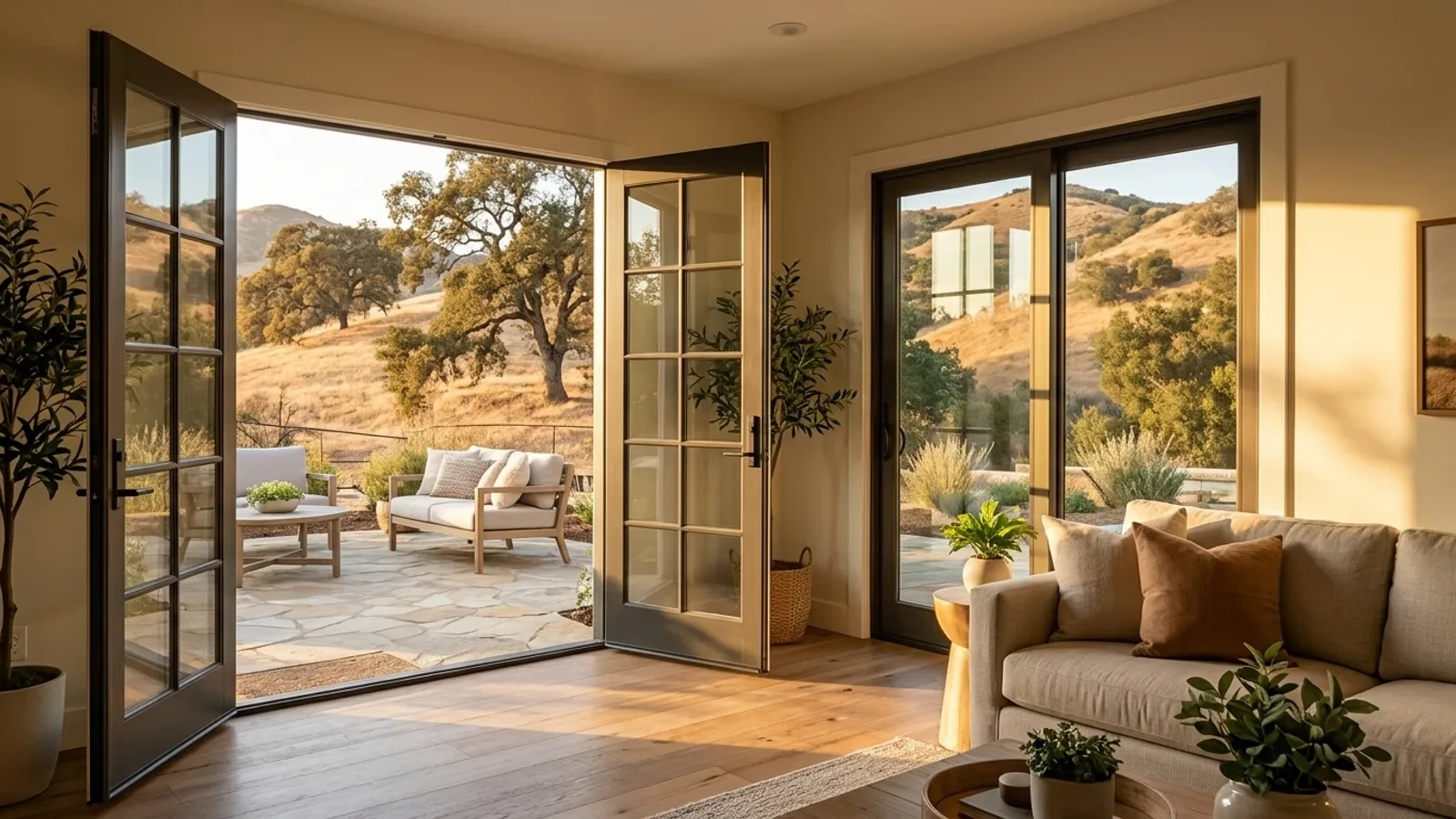
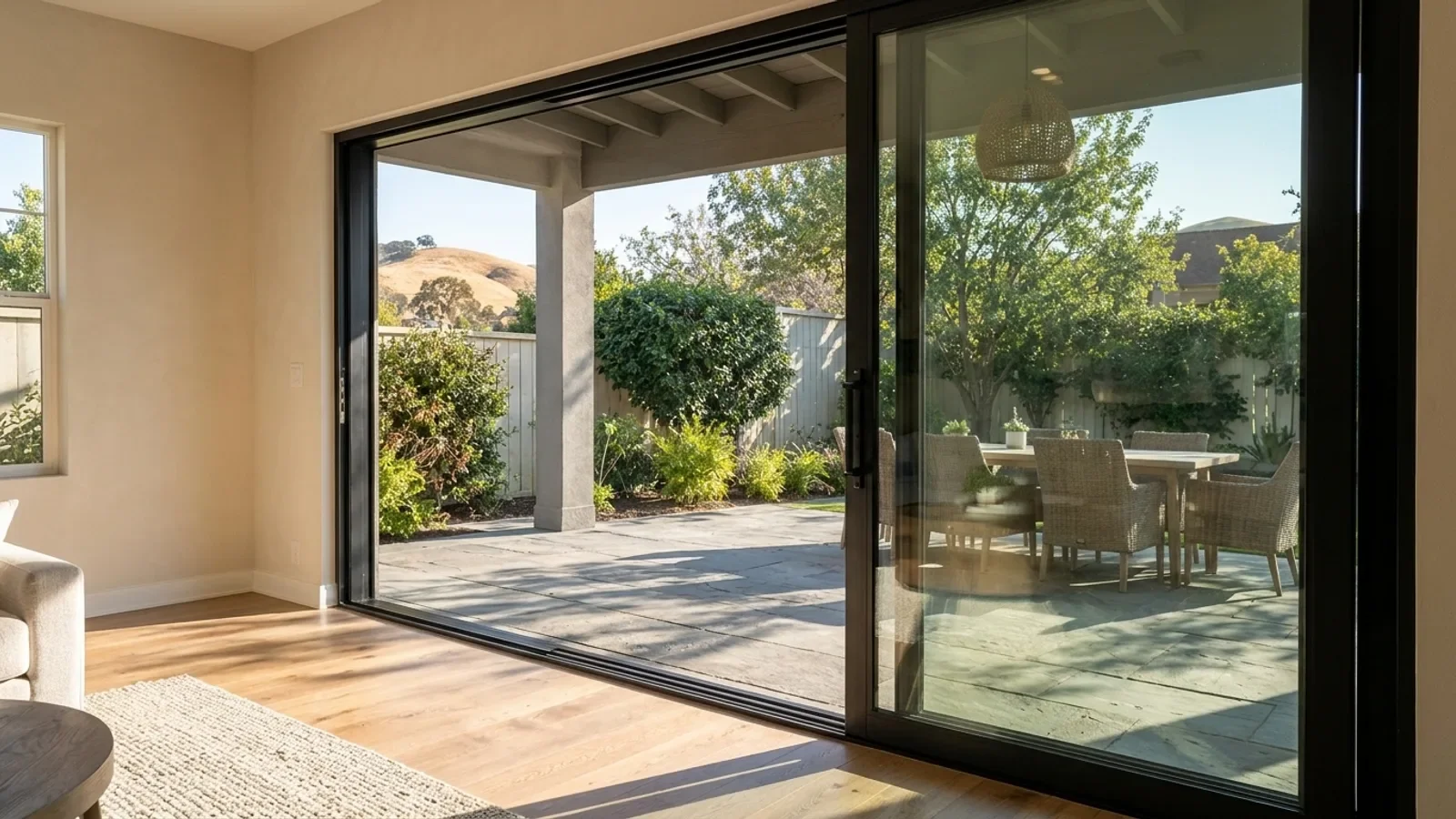
Bring your photos and ask the supplier to help you match the door style to your space. French patio doors swing open, so they need clear floor space where the doors travel. That’s the swing clearance. Sliding patio doors stay inside their own frame, which helps when a sofa or dining table sits close to the opening. Bifold doors fold back in panels and can open most of a wall, which is lovely for indoor-outdoor living but needs room for the stacked panels. A helpful supplier will ask about your furniture before recommending anything. If your room is snug, our guide to {{sibling:tight-space-patio-door-options-thousand-oaks|patio door choices for tight rooms}} walks through layouts. And the full side-by-side lives in our {{pillar_url|comparison of exterior French doors and sliding doors for local homes}}.
Ask to open and close every door you’re serious about. Roll the slider. Swing the French door. Fold the bifold. Feel for grinding, sticking or a loose latch. Then ask about the parts you can’t easily see. Rollers carry the full weight of sliding panels, so ask what they’re made of and whether they can be adjusted or replaced later. Ask about the lock too. A multipoint lock fastens the door in several spots at once, which usually seals tighter and feels more secure than a single latch. Finally, look at the weatherstripping, the flexible strips that close the gap between door and frame. It should be continuous and springy, with no gaps at the corners.
Small parts wear first. Ask about them.
Ask whether the supplier will work from your measurements or wants its own. Openings in older homes are rarely perfectly square, so a small error can mean gaps or a door that won’t close right. Then ask whether the door is a standard size or custom built to your opening. Custom work can cost more and take longer, but it often fits better than forcing a stock size. Ask for an honest lead time, from order to delivery. Ask what happens if a delivered unit arrives damaged. These answers matter more than they seem.
Ask for the warranty in writing, and read what it actually covers. Glass seals, frame finish, hardware and rollers are often covered for different lengths of time, so a single headline number can hide a lot. Ask whether installation affects the warranty, since some coverage depends on the door being installed a certain way. Ask whether installation is included, arranged separately, or left to you. Then ask for an itemized quote listing the door model, glass package, frame finish, hardware and any delivery charges. A clear quote makes comparing suppliers simple. Vague quotes make it hard.
Line up each supplier’s answers in your notebook. Patterns jump out fast.
Asking questions is a homeowner job. Removing and setting a large glass door is not. Patio doors are heavy, glass panels can shatter, and an opening sometimes hides problems like a sagging header (the beam above the door) or water damage under the sill. Call a licensed contractor if you see soft or stained flooring near the door, cracks in the wall around the frame, or if you’re changing the opening size at all. Changing an opening can touch the structure of the house. Permit rules for door replacement differ by project and location, so check with the City of Thousand Oaks or a licensed pro before work starts. If your current door already lets in heat or drafts, our checklist of {{sibling:signs-patio-door-leaks-heat-thousand-oaks|clues that a patio door is leaking heat}} can help you describe the problem when you call.
U-factor and SHGC matter most. For west- or south-facing doors, a lower SHGC usually keeps rooms cooler, and a lower U-factor helps hold indoor temperatures steady overnight.
They can be, as long as the frame has a thermal break and the glass has a low-E coating. Aluminum’s strength allows slim frames and large glass, while the thermal break slows heat moving through the metal.
Yes. Photos of the opening, the floor and nearby furniture help a supplier suggest a door type that opens without blocking your room.
Compare them line by line: same door type, same glass package, same frame finish and same hardware. If one quote leaves out delivery or installation details, ask before deciding.
When you’re ready to see French, sliding and bifold doors in person and put these questions to work, stop by and browse our {{service|patio door selection in Thousand Oaks}}. Bring your measurements and photos, and we’ll walk through the options with you.
Get expert advice for your project.
Contact us today!